Removing Invasive Plants for a Bird Friendly Habitat
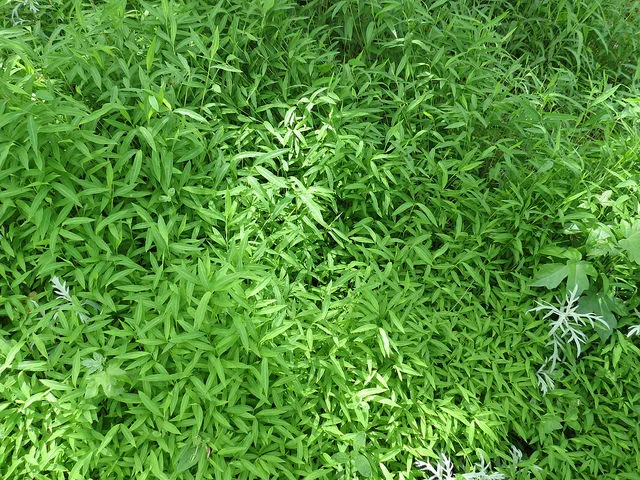
Japanese Stiltgrass taking over a yard
Invasive plants such as English ivy and privet are not originally from North America. They have escaped cultivation and now overrun native vegetation. The list in our brochure represents the invasive species that we have seen most often on our certification site visits. We ask that property owners remove invasives considered as Severe or Significant Threats by the NC Invasive Plant Council to achieve Bird Friendly Habitat certification. To be certified, invasive plants cannot cover more than 15% of the property.
We have imported many of the common plants that you see in neighborhood gardens based largely on their value as ornamental, lawn and garden plants. Thus native plants have been displaced as land has been developed. While some non-native plants stay within the confines of our gardens and can be used as decorative and ornamental species, they do not offer much value for wildlife especially since they do not host the insects which are an essential part of an intact and bird-friendly ecosystem.
Other imported, non-native plants readily and aggressively spread outside their original boundaries displacing native plants and becoming serious threats to ecosystems such as wetlands and the wildlife that depends on them. Most people don’t even realize that commonly seen plants like Bradford Pear trees, Chinese Privet, Japanese Honeysuckle, and Nandina are non-native and have become serious invasive threats.
The North Carolina Botanical Garden has written a very helpful booklet, “Controlling Invasive Plants,” which New Hope Bird Alliance recommends. We gave them a grant to reprint it in the spring of 2020 to make it more widely available.
Invasive Plant Removal Services
We recommend the following companies for removal of invasive plants if you have a problem to deal with that you cannot control yourself. If they are going to apply herbicides, which are sometimes necessary for control, we suggest that you verify with the company that they have a current “commercial applicator license for pesticides” as required by NC to safely apply herbicides in commercial applications.
Name
Website, email, phone
Brief outline of area and services (see website for more information)
Residential and small natural areas in Orange Durham and Chatham Counties. We identify all the natives to be protected, cut and paint shrubs, and spray any invasive groundcover. All sites require follow-up work with ongoing monitoring in the future.
Eco Guy Environmental Consulting
Sam Wright
Prefers to be contacted by email at [email protected]
(305) 775-3678
Sam is a plant ecologist offering invasive plant removal for homeowners and habitat restorations. He also offers small scale plantings, sourcing native plants from local nurseries. Most of his projects are local; Chapel Hill, Durham, Hillsborough.
Native Plants Matter NC, LLC
Robbie Davis,
Prefers to be contacted by email at [email protected]
(919) 866-8305
Robbie and his team are located in Raleigh, NC, and serve areas within an hours’ drive. He primarily uses manual removal methods and applies herbicides only when necessary. He has experience working with Homeowners’ Associations on invasive species removal.
Piedmont Environmental Landscaping and Design
Robbie Davis,
Prefers to be contacted by email at [email protected]
(919) 866-8305
Use various mechanical and chemical controls of terrestrial weed species including cutting, painting and spraying. Project areas are typically less than one acre. Serve a 25 mile area from Carrboro including much of Orange, northern Chatham, and western Durham Counties.
Mr. Morris has 20 years’ experience removing invasive species and serves on the North Carolina Invasive Plant Council board. He and his licensed team handle projects of all sizes, from residential yards to large tracts across Durham, Orange, Chatham counties, and beyond.
New Hope Bird Alliance depends on the community to help fund meetings, educational resources, and conservation efforts. Make a donation* to help protect North Carolina’s wildlife for years to come. Thank you for your support!
*Donations are tax-deductible to the full extent provided by law.