
Right now it’s hot and humid outside, but soon fall will be here, which is a great time for planting those bird-friendly perennials, shrubs and trees. Planting in the fall allows these plants to establish a root system before it starts to get hot again. If you are looking for plants which are not so appealing to the deer, try any type of native mint, Joe-Pye weed (Eutrochium fistulosum), American Beautyberry (Calicarpa americana), Spicebush (Lindera benzoin), or Sweet pepperbush (Clethra ainifolia).
For more ideas on native and deer resistant plants, check out the Native Plant page on our website. Many of these plants are great for pollinators as well as birds. Butterflies and bees have been enjoying the Joe-Pye in my yard, and then the goldfinch enjoy the seeds.
The same is true of coneflowers (Echinacea sp), and beebalm (Monarda sp). Goldfinches and other small birds love to get the seeds off these plants.
Soon migrating birds will be looking for berry producing shrubs to help fuel their migration to other places. Our native shrubs produce berries which are high in fat and most beneficial to wildlife. A good place to look for many of these native plants is the plant sale at the North Carolina Botanical Garden or at any of the native plant retailers listed on our website.
During the fall take advantage of all those leaves that magically drop in your yard to help birds, insects, and other wildlife. The best option is leaving the leaves in your yard as many insect larvae use the leaves to winter over. Many ground feeding birds also rely on these insects for food during the winter.
An option is to create piles of leaves in different locations through your yard. Birds can use these as places to hide or look for food, just as they use brush piles. Another option is to run over the leaves a few times with a lawn mower to shred them if they are too large.
Now is the time to take out that nasty Japanese stiltgrass which has spread everywhere before it sets seed. The seed can be viable for up to seven years, so you want to either pull it up, mow it, or use a weed whacker to prevent it from going to seed in the next few months. Cover areas that had stiltgrass with layers of leaf mulch to prevent it from reappearing.
Remove any privet, nandina, or mahonia before they produce berries, or at the very least, strip the berries off the plants before they can be spread. These invasive plants are spread by birds who eat the berries. The berries from nandina are actually toxic to birds if eaten in large quantities. See the Invasive Plants section of our website for more ideas on controlling invasives.
Finally, don’t forget to have water available in your yard. A water feature is a great way to attract birds as they fly south, especially if they can hear the water falling. Water can also be provided in container or shallow dishes. Birds like to take baths to help rid their feathers of dirt and parasites.
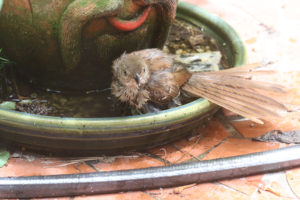 Brown Thrasher taking bath
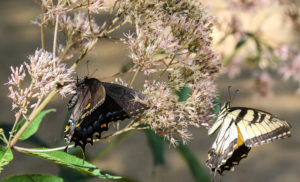 Black and Yellow Tiger Swallowtails on Joe-Pye Weed
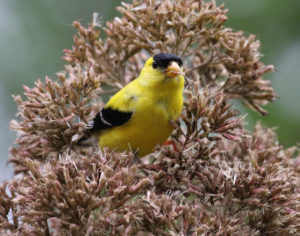 Goldfinch eating Joe-Pye seeds
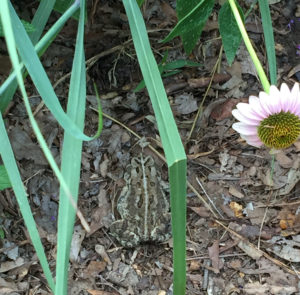 Toad disguised by leaf litter
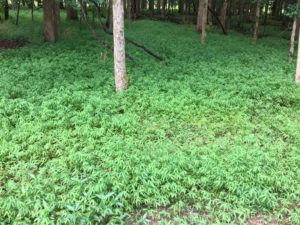 Stiltgrass taking over